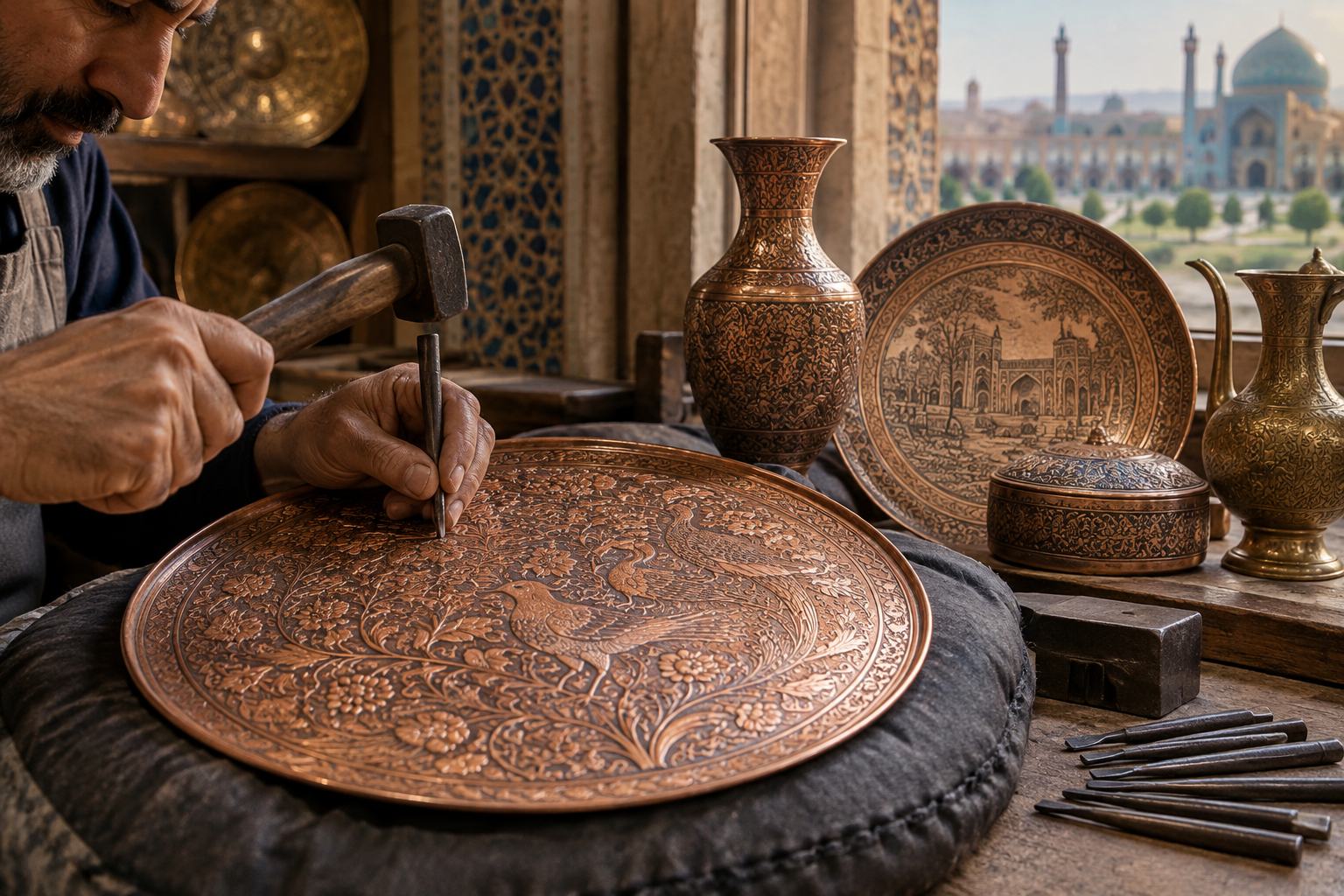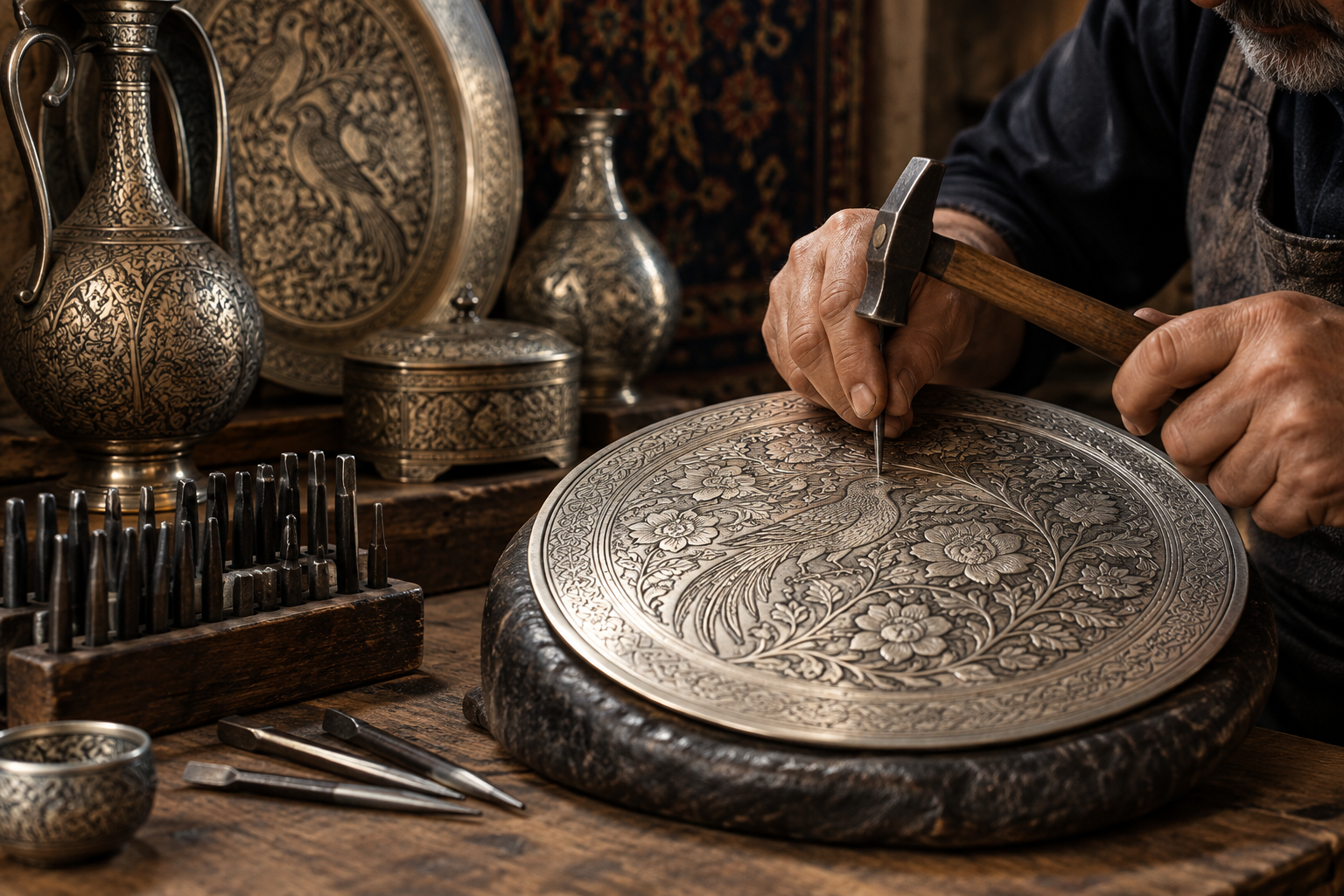
In a quiet workshop, away from the bustling grand bazaar, a steady, rhythmic tapping fills the air. It is a sound that has echoed through the city of Isfahan for centuries—the sound of creation. An artisan, with posture honed by years of practice, leans over a gleaming sheet of copper. In one hand, a small, elegant chisel, the ghalam. In the other, a hammer. With each precise strike, a silver line blossoms on the metal's warm surface, part of a sprawling, intricate design taking shape from the artist’s vision. This is Qalamzani, a revered form of Persian metal engraving that is less a craft and more a conversation between the artisan, the metal, and a profound cultural history.
Passed down through generations of Isfahani masters, Qalamzani is a testament to the enduring power of handmade artistry in a world hurtling toward automation. Every single line, curve, and stippled texture that adorns these metallic canvases is carved painstakingly by hand. It is a discipline demanding immense patience, a rock-steady hand, and an artist's soul. As one watches a master at work, it becomes clear that this is more than decoration; it is storytelling forged in metal, a heritage hammered into tangible form.
An Echo Through Millennia of Metal
While Qalamzani is famously centered in Isfahan, the Persian mastery of metal is a tradition with roots reaching deep into antiquity. The legacy of working with alloys like brass, copper, and Varsho (nickel silver)—typically a non-ferrous blend of 60% copper, 20% nickel, and 20% zinc—is a cornerstone of Iranian material culture. These materials serve as the canvas for a craft that has survived millennia of dynastic shifts.
“Every great king has a story. And in Persia, those stories are often hammered into metal, a testament to a legacy that endures.”
From the battlefield to the royal court and finally to the artisan's workshop, the journey of Persian metalwork is one of evolution. The focus shifted from pure function to a sublime fusion of utility and beauty. Vessels, trays, lamps, and decorative plaques became canvases for depicting lush gardens, epic poems, and celestial patterns. The hammer that once forged armor now strikes to create art, but the spirit of dedication and mastery remains unchanged.
The Artisan's Sanctum: The Anatomy of Qalamzani
The creation of a Qalamzani piece is a methodical and meditative process, beginning long before the first tap of the hammer. The journey starts with a simple blank of metal—often copper, brass, or silver—which must be prepared to perfection. The surface is diligently prepared and polished to a flawless sheen, ensuring it is ready to receive the thousands of delicate marks that will bring it to life. Some artisans will coat the blank with a dark varnish, so that each engraved line appears in shining contrast, allowing them to track their progress.
The Sacred Tools and Meticulous Process
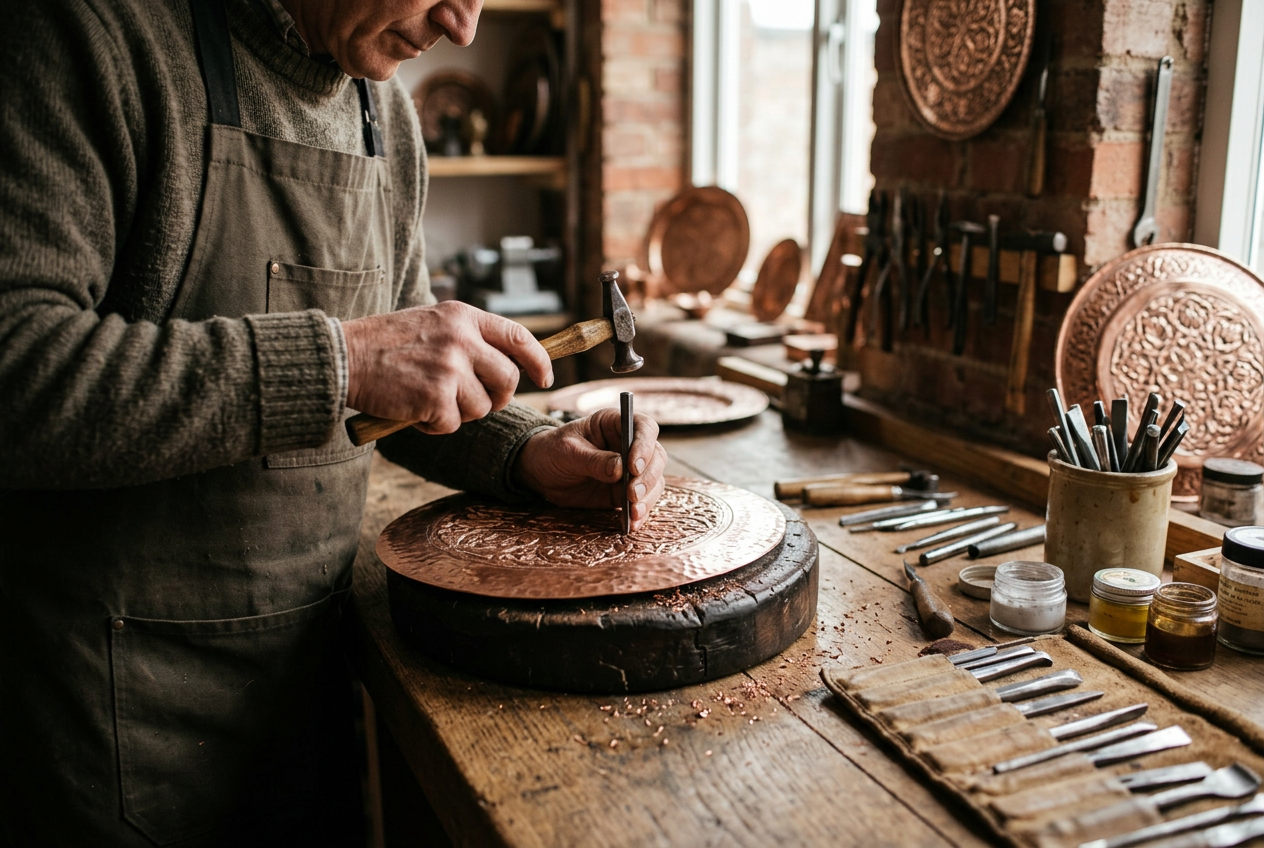
At the heart of the craft are the simplest of tools: a small hammer and an array of steel chisels, or ghalams. These are not complex machines, but intimate extensions of the artisan's hands. Each chisel has a different tip—fine, flat, rounded, or patterned—used to create a variety of textures and line weights. The artisan holds the ghalam in one hand, angling it just so, and taps it with the hammer held in the other. It is a dance of two hands working in perfect unison, one guiding and one providing the force, again and again.
- Preparation and Design: The metal sheet is selected, polished, and sometimes coated. The artist then sketches the intricate design directly onto the surface or transfers it from a template.
- Engraving (Qalamzani): Using a hammer and a variety of chisels, the artisan meticulously engraves the design. This is the most time-consuming phase, where the piece's primary form and detail are established.
- Detailing and Shading: The artist works back over the piece with finer-tipped ghalams to add texture, depth, and the subtle shading that gives the design its three-dimensional quality.
- Finishing: The piece is cleaned and the dark coating is often removed from the engraved lines, creating a brilliant contrast. A final polish protects the metal and enhances its luster.
The sheer patience required is staggering. A moderately complex copper piece can consume over forty hours of concentrated effort. Larger, more elaborate masterworks can command hundreds of hours. This is not hurried work; it is a slow, deliberate act of devotion. Each line is a commitment, a permanent mark on the metal canvas. There is no 'undo' button in Qalamzani, which makes the flawless execution seen in finished pieces all the more remarkable.
- Core Tools
- 2
- Time for a Medium Piece
- 40+
- Tradition Age
- Centuries
- Mistakes Tolerated
- 0
Hammer and Chisel (Ghalam)
Hours of continuous, focused work
An unbroken lineage in Isfahan
Every line engraved is permanent
Isfahan: Cradle of a Metallic Renaissance
To speak of Qalamzani is to speak of Isfahan. This city, a historic capital of Persia and a jewel of Islamic art and architecture, remains the undisputed heartland of the craft. Its enduring relevance was recently highlighted at international platforms like the BRICS Bazaar, where Iranian metalwork—including intricate brass utensils and sculptures—continues to represent the nation's cultural heritage to a global audience.
This master-apprentice relationship is central to the survival of Qalamzani. Knowledge is transferred not through textbooks, but through observation, practice, and direct guidance. The student learns to feel the metal, to understand its resistance and potential, and to control the force of each hammer strike to a hair's breadth. It is this living, breathing method of education that has allowed the art form to maintain its integrity and quality over such a long period.
“Every line you see is carved by hand. It's a dialogue between the artisan, the metal, and centuries of Persian tradition.”
The Motifs and Materials That Tell the Story
The choice of metal is the first verse in a Qalamzani story. Each has its own character and responds differently to the ghalam. Copper is a frequent choice for its warm, reddish glow and forgiving malleability, allowing for deep and fluid engraving. Brass, an alloy with a noble history in Persia dating back to at least the Sassanian period, offers a golden hue that exudes richness. For the most precious works, silver and even gold are used, their brilliance forming the ultimate canvas for miniature-level detail.
- Copper: Prized for its warm color and workability, ideal for intricate pieces that require extensive engraving.
- Brass: A traditional alloy of copper and zinc with a golden appearance, used historically for everything from armor to decorative vessels.
- Silver & Silver-Plate: Used for high-value items, offering a bright, reflective surface that highlights the dark, oxidized lines of the engraving.
- Gold: The most luxurious material, reserved for bespoke commissions, ceremonial objects, and museum-quality masterpieces.
Upon these metallic surfaces, a rich vocabulary of Persian motifs comes to life. Classic designs include the Gol-o-Morgh (flower and bird), symbolizing the divine and the soul's yearning. Intricate arabesques and spiraling Eslimi patterns create a sense of infinite movement and harmony. Other pieces become narrative scrolls, depicting scenes from the epic poems of Ferdowsi, the lyrical verses of Hafez, or historical events, echoing the sentiment that behind every great story is a piece of art waiting to be made.
The Role of Varsho in Persian Metalwork
A significant though specialized material in the Persian engraver's repertoire is Varsho, or nickel silver. Unlike pure silver, this alloy is prized for its bright white lustre and durability, achieved through a specific ratio of nickel and copper. Historically used for household items and decorative plaques, Varsho requires a steady hand during the engraving process due to its mechanical characteristics, offering a distinct aesthetic contrast to the warm tones of traditional brass and copper.
Levels of Mastery: Assessing the Craft
Like any venerable art form, Qalamzani exists across a spectrum of complexity and skill. While simple, charming pieces are available as souvenirs, the true soul of the art lies in the work of dedicated career artisans. The value of a piece is determined not just by its size or material, but by the density of its design, the precision of its execution, and the sheer number of hours invested by its creator.
| Tier | Description | Estimated Time (for a 30cm plate) |
|---|---|---|
| Souvenir Grade | Simple border motifs, often with large open spaces. Lines may be less consistent and sometimes partially machine-aided. | 2-5 Hours |
| Artisan Grade | Fully hand-engraved surface with classic floral or geometric patterns. Clear, confident lines executed with skill and patience. | 30-60 Hours |
| Masterpiece Grade | Extremely dense, intricate designs, often featuring miniature narrative scenes, flawless geometric grids, or multi-layered textures. Execution is perfect. | 100+ Hours |
| phase | percent |
|---|---|
| Preparation & Design | 15 |
| Primary Engraving | 50 |
| Fine Detailing & Texture | 25 |
| Finishing & Polishing | 10 |
Preserving a Living, Breathing Heritage
In an age of instant gratification, the quiet, meditative discipline of Qalamzani is a powerful antidote. It is a tangible connection to a deep and rich history, a craft that places human skill and dedication above all else. Supporting this tradition is not just about acquiring a beautiful object; it is about sustaining a cultural ecosystem that has flourished for centuries.
- Cultural Identity: It serves as a cornerstone of Isfahani and Iranian artistic heritage, embodying a key part of the national aesthetic.
- Master-Apprentice Lineage: Skills are passed directly from one generation to the next, a method that ensures authenticity and unparalleled quality.
- Global Appreciation: A growing international audience of collectors and art lovers values the soul and uniqueness of handmade crafts over mass-produced goods.
- Artistic Versatility: The technique is incredibly adaptable, applicable to everything from small jewelry boxes to monumental architectural features.
The future of Qalamzani rests, as it always has, in the skilled hands of its artisans and in the appreciative eyes of those who recognize its value. Each piece is a repository of time, a story told through countless, deliberate taps of a hammer. It is a centuries-old tradition, a living history, and a defiant celebration of the human touch in a world that too often forgets its worth.
Frequently asked questions
- What is the difference between Qalamzani and other metalwork?
- Qalamzani is primarily a surface engraving technique where artisans use a 'ghalam' (chisel) and hammer to create intricate patterns. Unlike repoussé, which shapes metal from the reverse side to create high relief, Qalamzani focuses on the precision of the lines and textures carved directly into the face of the metal, often featuring motifs like the Gol-o-Morgh.
- What metals are most commonly used in Persian Qalamzani?
- Traditional Qalamzani utilizes copper, brass, and silver. In specialized Persian metalwork, an alloy known as Varsho (nickel silver) is also used, consisting of approximately 60% copper, 20% nickel, and 20% zinc. Each metal is selected based on its workability and the desired final color, ranging from reddish copper to golden brass and brilliant white Varsho.
- Where is the center of Qalamzani production today?
- Isfahan remains the global epicenter for Qalamzani. The city's historic grand bazaar and specialized workshops house masters who have passed down these engraving techniques for generations. Recently, Isfahani metalwork has gained further international visibility through cultural exhibitions and high-profile diplomatic showcases like the BRICS Bazaar, highlighting its status as a living heritage.
- How long does it take to create a single piece of Qalamzani?
- The timeframe depends entirely on the complexity and size of the object. A standard copper plate with moderate engraving may take over forty hours of labor. However, large-scale masterworks or items featuring highly dense floral and geometric patterns can require months of dedicated daily work by a master artisan to complete.
- What are the common motifs found in Persian metal engraving?
- Artisans typically employ a rich vocabulary of Persian symbols, most notably the 'Gol-o-Morgh' (flower and bird), which represents divine longing. Other common designs include hunting scenes, verses of Persian poetry, and intricate geometric patterns known as 'Eslimi' (arabesque), all of which are hammered by hand into the metal surface.
Sources
- [1]Historical Trajectory of Varsho in Iran· Gold and Jewelry Magazine Iran
- [2]Object of the Day - Saint Louis Art Museum· slam.org