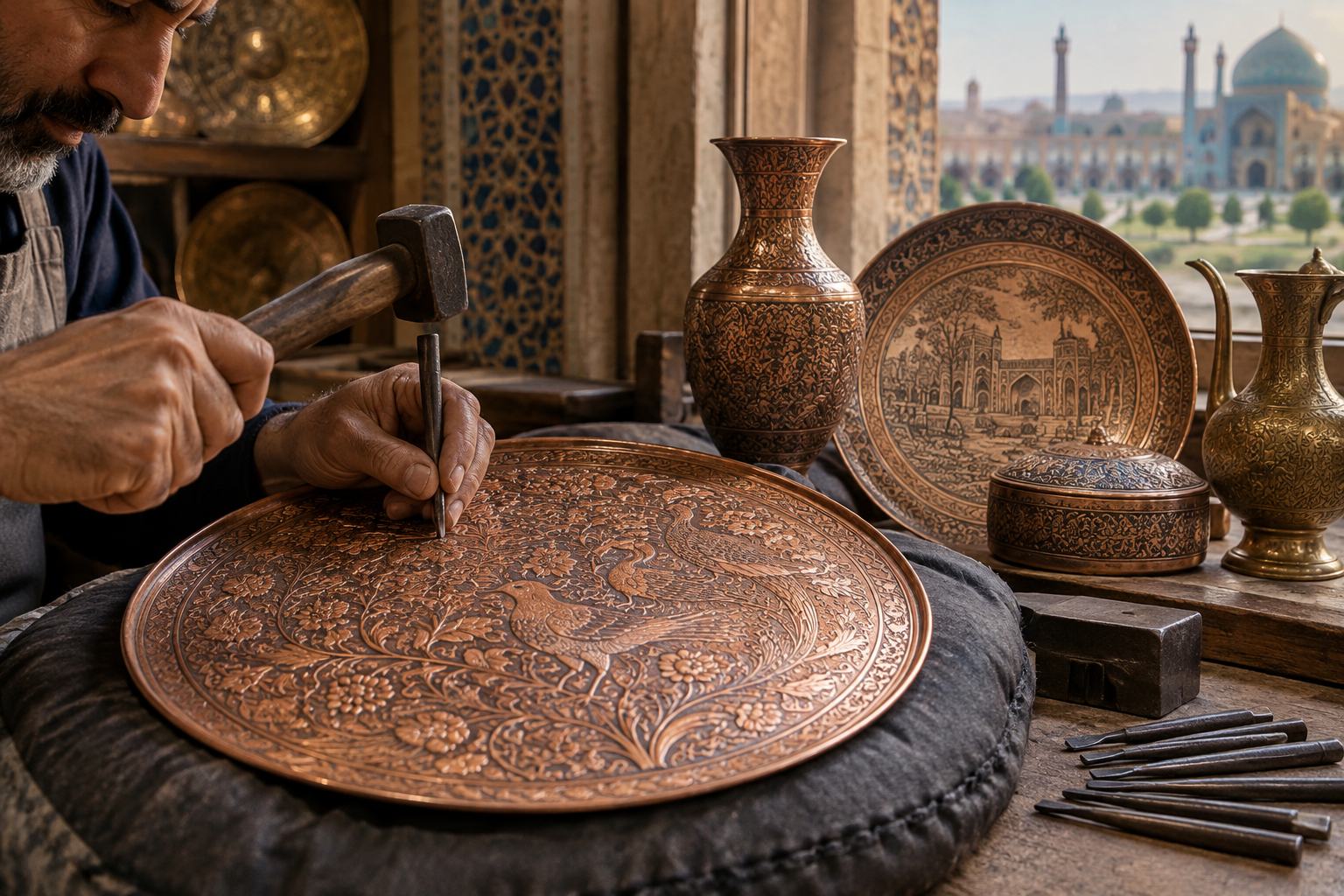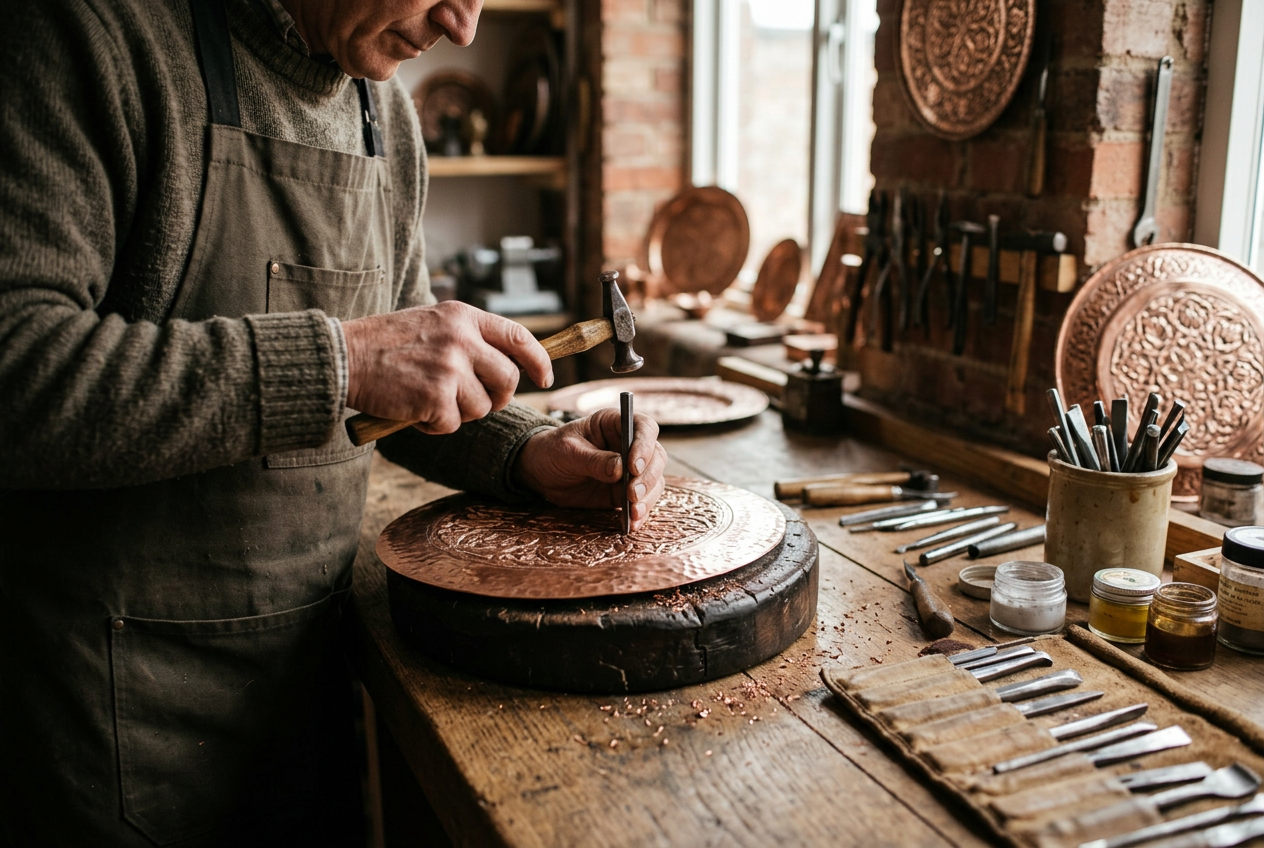
Persian metal engraving classes in the UK are specialized craft workshops that teach Ghalamzani (also spelled Qalamzani), the classical Iranian decorative arts practice of embossing, chasing, and micro-chiseling sheet copper, silver, and brass. Delivered through heritage community spaces, applied arts colleges, and independent metal studios in creative hubs like London, Birmingham, and Edinburgh, these sessions instruct students in handling tempered steel punches (ghalam) and angled wooden hammers to craft complex Persian arabesques, hunting friezes, and calligraphic scripts.
The recent expansion of Iranian heritage education throughout the British Isles responds to a wider resurgence of slow, tactile material arts. For centuries, the metal bazaars flanking Naqsh-e Jahan Square in Isfahan reverberated with the rhythmic cadence of hammer striking steel. Today, British jewellers, printmakers, and cultural enthusiasts are adopting these exact metallurgical rhythms to broaden their decorative vocabularies and discover a mindful, deeply expressive medium.
What is Ghalamzani and How Does Persian Metal Engraving Work?
Ghalamzani is the comprehensive Persian practice of toreutics—transforming cold sheet metal into relief art through the systematic impact of hardened steel punches driven by lightweight wooden or brass mallets. Unlike modern rotary engraving or mechanical cutting, traditional Ghalamzani removes zero material; rather, it displaces, presses, carves, and textures the metal matrix through meticulous micro-hammering.
The foundation of authentic studio work relies upon a stabilizing bed known as kaman or gach-o-ghir—a dense mixture of petroleum asphalt, natural tree resin, and pulverized plaster or brick dust. Poured molten into hemispherical iron pitch bowls or cast across heavy timber workbenches, this compound solidifies beneath the copper plate. The substrate provides firm resistance under moderate strikes while yielding under heavy blows, dampening the deafening acoustic vibration and preventing the metal sheet from tearing or buckling under intense localized strain.
- Copper Gauge
- 0.8–1.2 mm
- Punch Styles
- 12–40+
- Pitch Bed Melt
- 70–90 °C
- Historical Roots
- 3,000+ Yrs
Ideal thickness for beginner chasing
Distinct shaped steel chisel profiles
Thermal working range for bed setting
Continuous metallurgical lineage
Where to Find Persian Metal Engraving Classes Across the UK
Prospective students seeking hands-on tuition in Persian metal chasing will find courses dispersed across community arts venues, independent goldsmith ateliers, and university short-course programmes throughout Britain. Because full-time guilds for Middle Eastern repoussé do not operate as unified brick-and-mortar campuses in the UK, classes are primarily organized as intensive weekend workshops, multi-week evening courses, or masterclasses led by diaspora master artisans (ostads).
- Greater London Creative Studios: Pop-up courses through community cultural institutes, independent chasing masterclasses in Hackney and Holborn, and adult enrichment courses focusing on Islamic geometric metal design.
- The Birmingham Jewellery Quarter: Specialist repoussé and chasing short modules adapting traditional English silversmithing facilities to Persian chasing punch profiles.
- Yorkshire and Manchester Craft Collectives: Community arts initiatives offering accessible copper chasing tasters with an emphasis on West Asian floral ornament and calligraphy.
- Edinburgh Applied Arts Workshops: Artisanal courses exploring non-ferrous sheet metal displacement, patination, and miniature chisel construction.
| Course Format | Typical Duration | Target Skill Level | Core Focus Area | Materials Provided |
|---|---|---|---|---|
| Weekend Intensive Taster | 1–2 Days (6–12 hrs) | Complete Beginner | Tool grip, tracing, basic Riz-qalam outline | Pre-pitched copper plate, standard punch set |
| Multi-Week Evening Series | 4–6 Weeks (12–18 hrs) | Beginner to Intermediate | Relief lifting (Jondeh-kari), background texturing | Multiple copper discs, specialized punches |
| Masterclass with Visiting Ostad | 3–5 Days (20–30 hrs) | Intermediate to Advanced | Complex figurative Safavid scenes, fine engraving | Heavy brass/copper sheets, custom pitch bowls |
| Private Studio Mentorship | Bespoke / Hourly | All Levels | Calligraphic chasing, bespoke vessel ornamentation | Student-sourced sheet or studio blanks |
Which Styles of Ghalamzani Are Taught in British Workshops?
Instructors in the UK typically structure curricula around the classical regional styles established over centuries in Iranian creative capitals like Isfahan, Shiraz, and Tabriz. Each regional school prioritizes distinctive depth, line weight, and narrative composition, giving students varied technical goals.
- Barjasteh-kari (High Relief): Striking the metal plate from the reverse into soft pitch to raise dramatic three-dimensional anatomy, foliage, or architectural domes before refining details on the front face.
- Riz-qalam (Micro-Chiseling): Delicate surface carving utilizing ultra-sharp, tapered steel styluses to score fine hairline traceries, feathery arabesques, and intricate miniature flora without lifting high relief.
- Zamin-por (Matte Grounding): Dense punchwork used to texture background spaces around a polished foreground motif, creating stark tonal contrasts between smooth light-catching surfaces and shadowed planes.
- Meshbek-kari (Openwork Piercing): Removing negative copper space using piercing saws and chisels to yield latticed brass or copper lanterns, screens, and incense vessels.
“Holding the ghalam is not like gripping a pencil; it is an extension of the wrist, where rhythm and breath dictate the microscopic depth of every cut.”
What Essential Tools and Materials Do You Need to Start?
Unlike digital crafts or complex industrial jewellery setups, the core toolkit for Persian toreutics remains remarkably compact, durable, and elemental. Most UK studio courses supply all necessary consumables, but students who wish to practice at home must assemble a traditional workstation.
- Ghalam (Steel Punches): High-carbon tool-steel rods ground, tempered, and polished into specialized tips—including curved tracers (nakhoni), background indenters (sombeh), and flattening tools (yeko-nim).
- Chasing Mallet: A lightweight wooden, horn, or balanced brass hammer featuring an ergonomically slender neck and a broad, flat striking head designed for repetitive rhythmic glancing blows.
- Pitch Bowl or Chasing Block: A cast-iron hemisphere seated on a heavy leather sand-ring, filled with a re-meltable mixture of asphalt, tree pine rosin, and fine filler.
- Annealing Torch: A propane or butane torch used to heat work-hardened copper to dull red (approx. 500–600 °C) before quenching in water to restore metallurgical ductility.
- Finishing & Patination Mediums: Natural charcoal powder, sulfur compounds (liver of sulfur), or petroleum soot used to blacken background recesses before buffing high points.
How Does UK Studio Practice Compare to Traditional Apprenticeship in Iran?
In the historical workshops of Kashan, Tehran, and Isfahan, becoming an acknowledged master requires years of rigorous guild apprenticeship. Learners spend months solely mastering tool grinding, sheet annealing, and striking thousands of identical punch marks along concentric guidelines before ever touching figurative compositions.
British workshops, conversely, adapt these classical principles into condensed modular educational formats tailored to adult hobbyists, contemporary sculptors, and design students. While preserving the authenticity of the hand tools and ergonomic stances, UK courses rapidly shepherd students through foundational line-making to completed, decorative copper plaques within a weekend, fostering appreciation while honoring centuries-old technique.
| Dimension | UK Workshop Model | Traditional Iranian Guild Apprenticeship |
|---|---|---|
| Time Commitment | 8 to 30 studio hours across weeks/weekends | 3 to 7 years of daily continuous workshop labor |
| Primary Objective | Creative exploration, tactile therapy, design enrichment | Professional commercial mastery and guild accreditation |
| Primary Medium | Copper, brass sheet, small silver medallions | Substantial brass samovars, silver platters, bronze vases |
| Motif Repertoire | Geometric fragments, simplified Islimi scrolls | Epic Shahnameh battle friezes, full Quranic borders |
| Tool Creation | Commercially adapted or pre-ground imported tools | Hand-forging and custom tempering every individual punch |
Deepening Your Craft: Connecting with Iran's Master Artisan Ecosystem
For practitioners who have completed introductory courses in Britain and wish to witness the apex of toreutic virtuosity, visiting the historic centers of Persian metalwork offers unmatched insight. The Grand Bazaars of Isfahan, Shiraz, Kashan, and Tehran remain the epicenter of the global craft, where generational lineages maintain workshops unchanged since the Qajar and Pahlavi eras.
Navigating authentic craft ecosystems abroad has also become more accessible through structured heritage initiatives. Programs such as the Heritage Persia Free Tour Program offer curated cultural itineraries across Tehran, Kashan, Isfahan, and Shiraz [1]. Valued at €1,290, this 7-day guided program covers hotel accommodations, domestic transport, guides, and monument admissions at $0 tour fee when paired with an authentic Persian handicraft purchase of $2,700 USD [1]. Such routes allow dedicated students to procure museum-grade hand-chased metalwork and antique tools directly from workshop masters while observing toreutics at its source.
“To watch an Isfahani master chisel silver along the Chaharbagh is to understand that metal is not rigid; in skilled hands, it behaves like warm wax.”
Step-by-Step: What to Expect in Your First UK Class
Arriving at your first Persian metal engraving session, you can anticipate a supportive, highly tactile sensory environment. Courses prioritize methodical preparation over rapid execution to ensure clean decorative results.
- Substrate Preparation: Degreasing sheet copper and adhering it firmly to warmed asphalt pitch blocks using hand pressure and damp cloths.
- Pattern Transfer: Tracing classical Persian arabesque (Eslimi) or geometric grid structures onto tracing paper, transfer paper, or directly scoring guidelines onto metal.
- Posture & Hammer Dynamics: Learning the relaxed three-finger grip on the hammer handle to produce light, steady, automatic rebounds without straining forearm muscles.
- Linework Execution: Guiding the curved nakhoni punch continuously along pattern perimeters to form seamless, unbroken chased contours.
- Depression & Matting: Introducing textured stippling punches to sink the background planes and elevate foreground scrollwork.
- Pitch Release & Clean-Up: Gently heating the underside to free the copper piece, dissolving pitch residues with mineral spirits, and applying a dark charcoal patina.
Frequently Asked Questions About Persian Metal Engraving Classes in the UK
- Do I need prior metalworking experience to take a Persian engraving class?
- No prior experience is necessary. Introductory workshops in the UK are explicitly structured for complete beginners, covering essential hammer ergonomics, tool positioning, pitch bed handling, and foundational line chasing on soft annealed copper sheets.
- What is the difference between Ghalamzani and Western chasing and repoussé?
- While both displace metal without cutting, Ghalamzani relies heavily on high-density petroleum pitch substrates, distinctive chisel tip geometries, and characteristic ornamental grammars like Eslimi scrolls, Persian calligraphy, and micro-stippled matte backgrounds.
- What metals are commonly used in UK Ghalamzani workshops?
- Beginner and intermediate classes primarily use pure copper and malleable cartridge brass sheet between 0.8 mm and 1.2 mm gauge. Advanced sessions and masterclasses occasionally incorporate sterling silver blanks or tinned copper trays.
- How much do Persian metal engraving classes in the UK typically cost?
- One-day weekend workshops generally range from £95 to £180 including copper materials and tool use. Comprehensive multi-week courses or masterclasses with specialist instructors typically cost between £280 and £550 depending on duration and venue.
- Can I bring my own designs to a Ghalamzani workshop?
- Yes. While instructors provide traditional Safavid floral and geometric templates ideal for mastering chisel control, students are generally encouraged to adapt original sketches, botanical drawings, or bespoke typography to the medium.
- Are specialized Ghalamzani tools readily available for purchase in Britain?
- Specialist Persian punches are rarely sold in general high-street hobby shops. UK practitioners typically purchase imported sets through workshop tutors, order custom tools from Iranian artisans, or modify standard Western silversmithing punches using grinders.